
Article: Introduction to Chonglinzhai Colored Stone Inlay Art Museum
Introduction to Chonglinzhai Colored Stone Inlay Art Museum
A hundred years is but a fleeting wave in the boundless river of time. Yet for a brief human life, it is a span almost impossible to cross. A time-honored brand that has endured for over a century is never the achievement of one generation alone. It requires generations of people to share the same aspirations and pass down the same faith. Amid the rapidly changing currents of the times, they must uphold enduring principles while maintaining the passion to keep pace with the world.

Chonglinzhai was founded in the late Qing Dynasty, in 1912. The name “Chonglin” carries the meaning of admiring and honoring the virtues of a gentleman.
The original shop was located at Daluoqiao in the old urban district of Wenzhou, now the eastern end of Guangchang Road. It has continued for more than a century.

The shop followed the traditional layout of a storefront in front and a workshop at the rear. It mainly produced and sold colored stone inlay and carving works, including hanging mirrors, small screens, decorative couplets, hanging panels, standing screens, cabinets, and chests. At the time, such shops were commonly known as “door-couplet shops” or “chest-panel shops.” Their products were sold locally and also exported, mostly to Germany, Belgium, France, and other countries. During the Republican period, this craft became one of Wenzhou’s pillar industries for earning foreign exchange through exports. Before the outbreak of the War of Resistance Against Japan, Chonglinzhai already had more than 70 employees.
After the war broke out, transportation was completely obstructed. Chonglinzhai artisans successively opened shops and set up production in the Xiaodongmen area of Shanghai, exporting directly from there. This model was later extended to Qingdao and Hong Kong, contributing to the rare foreign exchange reserves during wartime.

After the founding of the People’s Republic of China, Chonglinzhai and several handicraft workshops established the Wenzhou Art Cooperative, later known as the Wenzhou Art Carving Factory.
With the advancement of reform and opening up, in 1988, Miao Chengjin left the Art Carving Factory and revived the time-honored Chonglinzhai brand, which has continued to this day.
Lineage of Inheritance
Li Yuting, 1864–1941, was the founder. Around 1920, Chonglinzhai developed into a business with multiple branches, opening shops in Shanghai, Qingdao, Hong Kong, Singapore, and other places. Its works were sold overseas and were also exhibited at an international exhibition in Tokyo, Japan.

Wang Peizhen, 1902–1983, was the second-generation inheritor of Chonglinzhai and a representative figure in colored stone inlay. He was a distinguished disciple of Li Yuting. His major works include The Eight Immortals, The God of Longevity, The Romance of the Western Chamber, Fifteen Strings of Cash, Zheng Chenggong, and Eight Great Inventors of Ancient China. In 1959, the colored stone inlay screens Tea-Picking Dance and Liang Shanbo and Zhu Yingtai were displayed in the Great Hall of the People in Beijing as symbols of folk culture. Later, Wang Peizhen was recommended as a representative to the National Conference of Advanced Workers, where he was received in Beijing by Mao Zedong, Zhou Enlai, and other Party and state leaders.

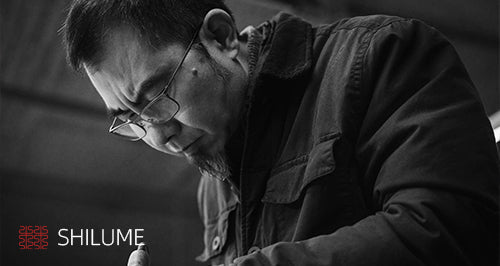
Miao Chengjin is the third-generation inheritor of Chonglinzhai and a distinguished disciple of Wang Peizhen. He is a national-level representative inheritor of the intangible cultural heritage project of colored stone inlay, as well as a Zhejiang Provincial Master of Arts and Crafts. Over his 65 years in the craft, his works have been widely collected by domestic and overseas institutions, including national-level museums, and have won numerous major awards at national exhibitions.

Miao Yichuan is the fourth-generation inheritor of Chonglinzhai. He studied the craft under his father, Miao Chengjin, from an early age and later lived overseas. In 2013, he returned to China and took on the responsibility of carrying forward the tradition. He is currently a representative inheritor of colored stone inlay in Wenzhou and serves as the general manager of Chonglinzhai. His works have won repeated awards at national exhibitions. Against the backdrop of the new era, he actively pursues innovation and integration, helping colored stone inlay break through limitations in the application of new materials and expand into broader product fields.

The current site of Chonglinzhai is located at No. 137 Longchuan Road, Yangyi Subdistrict, Lucheng District, Wenzhou. Covering an area of 1,853 square meters, it is a comprehensive base integrating design, production, sales, exhibition, and hands-on experience.

While continuing to operate and preserve traditional product categories, Chonglinzhai also combines expansion with innovation, developing artistic works suited to modern living spaces.

With “inheriting the classics and opening up the future” as its core philosophy, Chonglinzhai masters the essence of the craft while striving to reach new artistic heights. It is dedicated to creating a Chinese poetic way of life through contemporary aesthetics, forming an aesthetic model that originates from life, integrates into life, and rises above life.
Chonglinzhai has established three mutually supportive product systems: living-space art, high-end customization, and cultural-creative customization.
*Representative inheritor of the national intangible cultural heritage project of colored stone inlay.
*A representative brand for the integration and cross-disciplinary development of colored stone inlay in the new era.

Leave a comment
This site is protected by hCaptcha and the hCaptcha Privacy Policy and Terms of Service apply.